|

|
|
ALGARVE NEWSLETTER
|
|
|
|
|
|
Last weekend of one month, first of the next, and the Algarve is behaving accordingly. Around 30°C on the coast, mid-30s once you head inland, no rain anywhere in the forecast and nights that stay warm enough to sit outside until midnight without thinking about it. Which means the plan writes itself: lose the middle of the day, and give the evenings everything. Here is how we'd spend it.
|
|
|
|
🗺️ THIS WEEKEND AT A GLANCE
|
|
|
|
30th Ria Formosa Festival · Faro waterfront, from 6pm, free
Thirty years of this, and it still comes down to a plate of clams pulled out of the lagoon that morning, a cold beer, and a free concert you can hear from anywhere on the site.
FACARTE, 30th Fair of Agriculture, Hunting and Handicrafts · Conceição, Tavira, from 6pm tonight
The eastern Algarve's own country fair, thirty editions deep: livestock, craft, machinery, grilled food and a village that turns out in full.
Nights of the Bride of the Sea · Fuseta, Olhão, through Sunday
Four nights of music, dancing and street food on the waterfront of the whitest village on the Ria Formosa. Read the Cultural Bite below before you go.
Jazz at the Castle: Sara Badalo Quintet · Loulé castle, Saturday 11am, free
An hour of American songbook standards inside the castle walls, in the cool of a Saturday morning, and it costs nothing.
Festival of Our Lady of Navigators · Salema, Vila do Bispo, Saturday and Sunday
A proper small-village festa held on the avenue right beside the sand, run by the local recreational club. Food, cakes, and no tourist polish at all.
|
|
|
|
✨ PREMIUM PICK OF THE WEEK
|
|
|
Sagres Natural Park Sunset Tour by Jeep
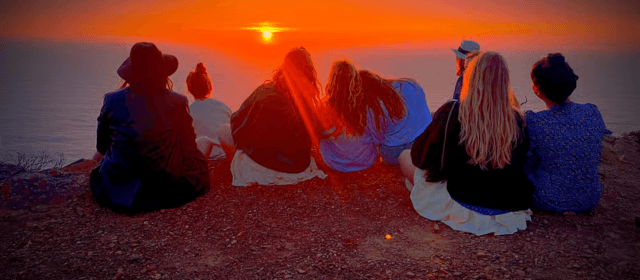
There is a specific hour on this coast, roughly the last one of the day, when the western cliffs go from beige to copper and the Atlantic underneath turns dark. Most people watch it from the car park at Cabo de São Vicente with two hundred others. This tour takes you somewhere else.
Four hours in an open jeep out of Lagos, through Vila de Sagres and the Cape, then off the tarmac entirely: a beach you would not find on your own, and a second spot on cliffs 140 metres above the water where the sunset actually happens. The Costa Vicentina is the wildest coastline in southern Portugal and this is the least effortful way to see the part of it that has no road.
👉 More Info
|
|
|
|
Sítio das Fontes, Estômbar: Where the Algarve's Biggest Aquifer Comes Up for Air
Everyone knows the Arade as the river you cross on the way to Portimão. Almost nobody stops at the point where it stops being a river. Eighteen hectares of municipal park sit on the estuary's left bank just north of Estômbar, and the name says what makes it strange: fontes, springs. This is where the Querença-Silves aquifer, the largest body of groundwater in the Algarve, finally reaches the surface and pushes out fresh water at the heaviest flow in the region.
The effect is a place that does not behave like the rest of the coast in August. Salt marsh on one side, reed bed and Mediterranean scrub on the other, cold water running through the middle, and shade. There is a restored tide mill with its weir and its old metal irrigation wheel, a miller's house, a nature interpretation centre, an amphitheatre and a marked trail of about 4km out and back that takes under an hour at a slow walk. On a clear morning the estuary fills with wading birds.
|
|
|
|
The White Bride of the Sea
Fuseta spends this weekend throwing itself a party called the Nights of the White Bride of the Sea. It is not a slogan somebody invented for a poster. It is what the village has called itself for generations: a low, lime-white fishing town sitting exactly where the Ria Formosa opens out toward the ocean, permanently dressed for a wedding it keeps having with the water.
The whiteness is not decorative either. Walk the older streets here or in nearby Olhão and you are walking through something that looks far more like the Moroccan coast than the rest of Portugal: flat-roofed cubes stacked in steps, lanes barely wide enough for two people, lime walls throwing the heat straight back at the sky. The style came by boat. From the 18th century onward, fishermen and traders from this stretch of the Ria ran a steady route across the Strait of Gibraltar to Morocco and Tunisia, and they brought the architecture home in their heads along with the cargo.
The flat roof has a name, açoteia, and it earned its place. Figs and fish were laid out on it to dry in the sun. Washing hung there. And because every roof is flat and the town is low, a woman standing on her own açoteia had an unbroken line of sight across the rooftops, over the sandbar, to the open sea. Which is where her husband was. Long before radio, before harbour telephones, the açoteia was how these towns watched their boats come back in. Some of them did not.
That is the thing worth carrying down to the waterfront this weekend. The bride of the sea is not a compliment about the view. It is a village that married the water, took everything it gave, and spent three centuries standing on the roof waiting to see what it would return.
|
|
|
|
|
This space is reserved for community highlights and local businesses we love. Are you a maker, host, restaurant or small business in the Algarve? Reply to this email to feature here.
|
|
|
|
|