|

|
|
ALGARVE NEWSLETTER
|
|
|
|
|
|
This is the hottest weekend of the summer so far, and the forecast is not subtle about it. Around 34°C on the coast today, 33 tomorrow with Silves and the interior pushing 37 by mid-afternoon, back to the low thirties on Sunday, no rain anywhere and nights that never drop below 20. So the plan writes itself: give up on the middle of the day entirely, find water or shade until six, and then let the evening do all the work. Everything worth doing this weekend happens after dark anyway. Here is how we'd spend it.
|
|
|
|
🗺️ THIS WEEKEND AT A GLANCE
|
|
|
|
XXI Medieval Fair of Silves · Silves old town, tonight through 15 August, 6pm to 1am
The whole medina closed to traffic, the Medieval Procession leaving at six sharp, and nine nights of a town playing itself a thousand years ago. Read the Cultural Bite below before you go.
Enchanted Village, White Night · Paderne, Albufeira, Saturday from 7pm, free
Paderne dresses entirely in white and so does everyone who turns up. Narrow streets, lights strung overhead, dancing in the corners. Wear white or feel conspicuous.
Traditional Festivals in Honor of the Fishermen · Santa Luzia, Tavira, tonight through Monday, from 8pm
Portugal's octopus capital, one street wide, throwing its annual party for the people who catch it. Grilled food on the waterfront and the entire village out until midnight.
Noites no Mirante · Monchique, tonight and Saturday, free
Two nights of music and street food up in the Monchique hills, which on a weekend like this one is also the coolest air in the Algarve. Worth the drive for the temperature alone.
Jazz at the Castle, Paulo Sousa Trio · Loulé castle, Saturday 11am, free
An hour of guitar-led jazz inside the castle walls, in the last part of Saturday morning that is still comfortable. Free, and the best-value hour of the weekend.
|
|
|
|
✨ PREMIUM PICK OF THE WEEK
|
|
|
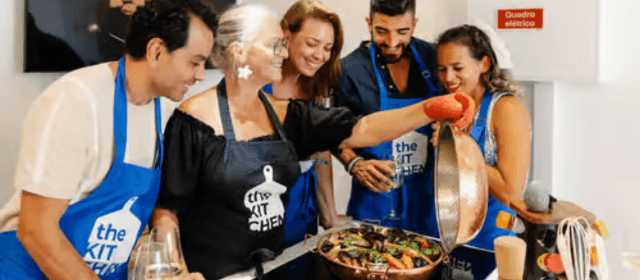
Lagos: Market Tour and Cataplana Cooking Class
Almost every food thing happening in the Algarve this month, the sardine festivals, the seafood festival in Olhão next week, the regional sweets at FETAAL, comes back to the same short list of ingredients and the same handful of techniques. You can eat your way through all of it and still not know how any of it is made. This fixes that in an afternoon.
It starts in Lagos market, which is the point. You walk the fish counters with someone who knows which boat landed what, pick the ingredients yourself, and then take them back and cook a cataplana, the hinged copper pot that gave the dish its name and gives the Algarve its most recognisable plate. Three and a half hours, small group, and it finishes with the full meal you just made, wine included, plus the recipe to take home.
👉 More Info
|
|
|
|
Cachopo: The Last Village of the Serra do Caldeirão
Drive north out of Tavira and the coast disappears within twenty minutes. The road climbs into the Serra do Caldeirão through cork oak and gum cistus, the phone signal goes, and after about forty minutes you arrive at Cachopo: schist walls painted white, coloured borders around every door and window, and chimneys carved like lace. It is the most complete traditional village left in the northeast Algarve, largely because almost nobody comes here.
What makes it worth the drive is that the crafts are not a display. The Núcleo Museológico do Cachopo holds the record of how the serra actually worked, from prehistory to the present: blacksmiths, saddlers, weavers, the trades that kept these hills fed when there was no other economy. Then you walk out into the square and find A Lançadeira, where hand looms are still working wool, linen and cotton the same way. There are blacksmith and saddler workshops near the church, and the Igreja Matriz de Santo Estêvão itself has been a pilgrimage point since 1535. Out in the surrounding hills are stone windmills and the casas circulares, round dry-stone dwellings whose design goes back to prehistory.
This weekend it also happens to be at its loudest. The village is holding the Summer Festival in Honor of Our Lady of Sorrows from tonight through Sunday, which is when the emigrant families come back and the population multiplies. Go up in the late afternoon, look at the looms while it is still light, eat at the festa, and drive back down through air that is ten degrees cooler than the coast.
|
|
|
|
Xilb, the City of Poets
The Medieval Fair opening in Silves tonight has a theme this year: "Xilb, City of Poets and Sages." It sounds like festival copy. It is not. Xilb, or Shilb, was the name of Silves under Islamic rule, and for roughly two centuries it was the most cultured city in the far southwest of Europe, wealthier and more literate than Lisbon, exporting figs and dried fruit down the Arade to the Mediterranean and importing books and scholars in return.
The line everyone quotes comes from the geographer al-Idrisi, writing in the twelfth century. Silves, he said, was a city whose people were Yemeni Arabs and others who spoke pure Arabic, who could compose verse, and who were eloquent in speech, the upper classes and the common ones alike. Read that carefully, because it is a strange thing to say about a town. He is claiming that the labourers in the fields around Silves made poetry. Whether or not that was literally true, it was the city's reputation across al-Andalus, and reputations like that are not accidental.
The man at the centre of it was al-Mu'tamid ibn Abbad, who arrived here as a boy. At thirteen he led the expedition that took Silves and was left behind as its governor, and he grew up in this castle surrounded by the poets his father sent to educate him. He went on to rule Seville, annex Córdoba, and become the most celebrated poet-king of al-Andalus. Then in 1091 the Almoravids came out of North Africa and took everything from him. He died four years later in captivity in Aghmat, in Morocco, and the verses he wrote in that cell about the loss of his kingdom are the ones still anthologised nine centuries on. He never saw Silves again.
Which is the thing to carry up the hill with you this weekend. The sandstone castle at the top of the town is the best-preserved Moorish fortification in Portugal, and it is the same red rock a thirteen-year-old governor once stood on looking down at a river full of trading boats. The fair below it will be loud, lit and full of people eating from paper plates. That is fine. Silves has been that kind of city before.
|
|
|
|
|
This space is reserved for community highlights and local businesses we love. Are you a maker, host, restaurant or small business in the Algarve? Reply to this email to feature here.
|
|
|
|
|