|

|
|
ALGARVE NEWSLETTER
|
|
|
|
|
|
After the eclipse on Wednesday, this weekend has a hard act to follow, and it is doing better than you would expect. The heat has genuinely broken: around 28°C today, 30°C tomorrow, back to 28°C on Sunday, nights at 20 or 21 and no rain in the forecast anywhere. That means the middle of the day is usable again for the first time in three weeks. It is also the weekend of the Assumption, which in this region means the interior throws parties and the coast carries saints out onto the water. Here is how we would spend it.
|
|
|
|
🗺️ THIS WEEKEND AT A GLANCE
|
|
|
|
Seafood Festival, Olhão · Jardim do Pescador, tonight and tomorrow.
Two nights left of the biggest food event in southern Portugal, and they saved the best for last: Mariza tonight, Daniela Mercury tomorrow, both included in the ticket. The clams and oysters came out of the lagoon you can see from the tent.
Our Lady of Good Voyage, Alvor · Alvor, tonight to Sunday, from 7.30pm, free
The fishing village's patroness, honoured here for well over a century. Sunday is the one: mass at 3.30pm, procession through the village at 5pm, then the blessing of the boats and a river procession out across the Ria de Alvor.
47th International Folklore Festival · Luz de Tavira, tonight and tomorrow, 9.30pm, free
Groups from Portugal, Italy, Slovakia and Nicaragua in a village square in the eastern Algarve. Forty-seven editions, still free, still mostly locals in the audience.
Lagos MMFEST '26 · Luz, Lagos, tonight to Sunday, from 6pm, free
Three evenings of emerging bands in the village of Luz, fourth edition. The best free music on the western coast this weekend, and close enough to the beach to make an afternoon of it.
Jazz at the Castle: Scooby 4tet · Loulé castle, Saturday 11am, free
An hour of vocal-led jazz inside the castle walls, on the one Saturday morning in weeks when standing outside at eleven is actually pleasant.
|
|
|
|
✨ PREMIUM PICK OF THE WEEK
|
|
|
Alvor: Caves Boat and Kayak Tour
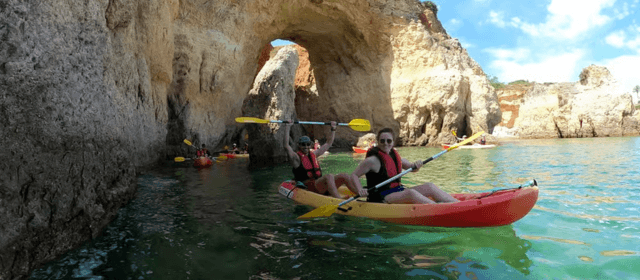
Alvor spends this weekend carrying its patroness out across the estuary, which is a good reminder that the interesting part of this stretch of coast is not the beach. It is what the water has done to the cliffs on either side of it. Between Alvor and Portimão the sandstone is riddled with caves, arches and small collapsed roofs that open to the sky, and almost none of it is reachable on foot.
This one solves the usual problem with cave trips, which is that the big boats can only look in from outside. You go out on a traditional Portuguese boat first, covering the distance in comfort, and then transfer to kayaks for the part that matters: paddling into the caves themselves, stopping on beaches that have no land access, and swimming off the boat. Three hours, small groups, guides who know which caves are safe at which swell. It rates 4.9 out of 5 across more than 250 reviews.
👉 More Info
|
|
|
|
Alcalar: The Algarve's Five-Thousand-Year-Old Necropolis
Ten minutes inland from the Alvor estuary, past Mexilhoeira Grande and up a lane that gives no indication of what is at the end of it, there is a hillside with eighteen tombs in it. They were built by people who lived here in the third millennium BC, on a ridge above what was then a navigable river, and they are the most important megalithic complex in the Algarve. Almost nobody goes.
The one to walk into is Monument 7. It is a tholos, a beehive tomb: a long stone corridor leading to a domed burial chamber with side niches, the whole thing buried under a cairn twenty-seven metres across. The construction technique, a false dome built by corbelling stone inward until it closes, is the same idea used at Mycenae, and it was being used here at roughly the same time by a community with no connection to Greece at all. Standing in the corridor, with the temperature dropping the moment you step in and the ceiling closing overhead, the distance between you and the people who cut those slabs feels considerably shorter than five thousand years.
The site is laid out as an open-air park with an interpretive centre, so you get context rather than a fenced-off mound. Give it an hour. Then, and this is why it is worth doing this weekend specifically, drive four minutes back down to Mexilhoeira Grande, where the church square is running the XXIII Arts and Flavours of Our Land from 6pm on Saturday and Sunday: honey, regional sweets, crafts, popular marches and live music, free entry. Five thousand years of the same hillside, in one afternoon.
|
|
|
|
The Emigrant Ball
Tonight at ten, in a place called Vale da Murta up in the Tavira hills, there is a dance called the Baile do Emigrante. Nobody has to explain the name to anyone who lives nearby. It is one of dozens across the region this month: Monte Francisco in Castro Marim has just held its thirtieth Festa do Emigrante, São Brás de Alportel held its own last weekend, and the villages of the serra will keep holding them until September. They all celebrate the same thing, which is that the people who left came back for August.
The leaving happened fast. Between 1960 and 1974 something like a million and a half people left Portugal, the largest emigration in the country's history, and a great many of them went without papers, walking over the Pyrenees in what was known as going a salto, the jump. They went to France, to Germany, to Switzerland and Luxembourg, to construction sites and factories and other people's kitchens. The Algarve interior emptied out. Villages in the Serra do Caldeirão and along the Guadiana that had held a few hundred families were left with a few dozen, mostly older ones, and the terraces went back to scrub. If you have driven through Alcoutim or Cachopo and wondered why there are so many roofless houses, this is the answer.
But the money came back every month, and in August so did the people. The pattern set itself early and it has never really broken: French plates on the cars, cousins who speak Portuguese with an accent from Lyon, grandmothers cooking for twenty. The village festa was rescheduled around it. That is why so much of the Algarve's calendar is stacked into these three or four weeks, and why the Assumption weekend, this weekend, is the busiest of the lot. The festas are not just religious. They are the one moment in the year when the whole village, including the two thirds of it that lives elsewhere, is in the same square at the same time.
So when you find yourself at a rural festa this weekend, in Giões or Santo Estêvão or Luz de Tavira, look at who is dancing. A good number of them flew in this month, from towns their parents left with a suitcase, and they will be gone by September. The accordion, the grilled food, the strings of lights over the polidesportivo: none of it is a performance for visitors. It is a family reunion that happens to be open to everyone.
|
|
|
|
|
This space is reserved for community highlights and local businesses we love. Are you a maker, host, restaurant or small business in the Algarve? Reply to this email to feature here.
|
|
|
|
|